
01
Configurable mission views
Arrange one to four 3D, ground-track, telemetry or graph tiles using layouts built for the task at hand.
AstroLink SEP · Satellite mission analysis software
Spacecraft Engineering Platform (SEP) is AstroLink’s satellite mission analysis software for mission engineers and space companies. Design satellites and constellations, propagate orbits, study ground-station access and analyze spacecraft power and eclipses in one native application.
Currently in testing · Discuss evaluation requirements

01
Arrange one to four 3D, ground-track, telemetry or graph tiles using layouts built for the task at hand.
02
Selection, camera targets, mission time and engine state stay synchronized across every active view.
03
Create satellites, Walker and elliptical constellations, ground sites and sensors, or import TLEs in batches.
Propagation
Edit a satellite in Keplerian or Cartesian form, choose the scenario-wide fidelity, and see the current state reconcile with the live engine.

01
Validated orbital elements, Cartesian state, mass and geometry remain accessible from one object page.
02
Select Earth zonal gravity through degree 70, JB2008 atmospheric drag and Sun/Moon DE440 perturbations.
03
Commands, snapshots and propagation run through the same memory-safe native core used by SEP.
Satellite access and ground-station analysis
Connect the spacecraft to the ground segment. SEP brings ground-station modeling and station-to-satellite access analysis into the mission workspace, so your team can examine where and when a station can see a satellite.
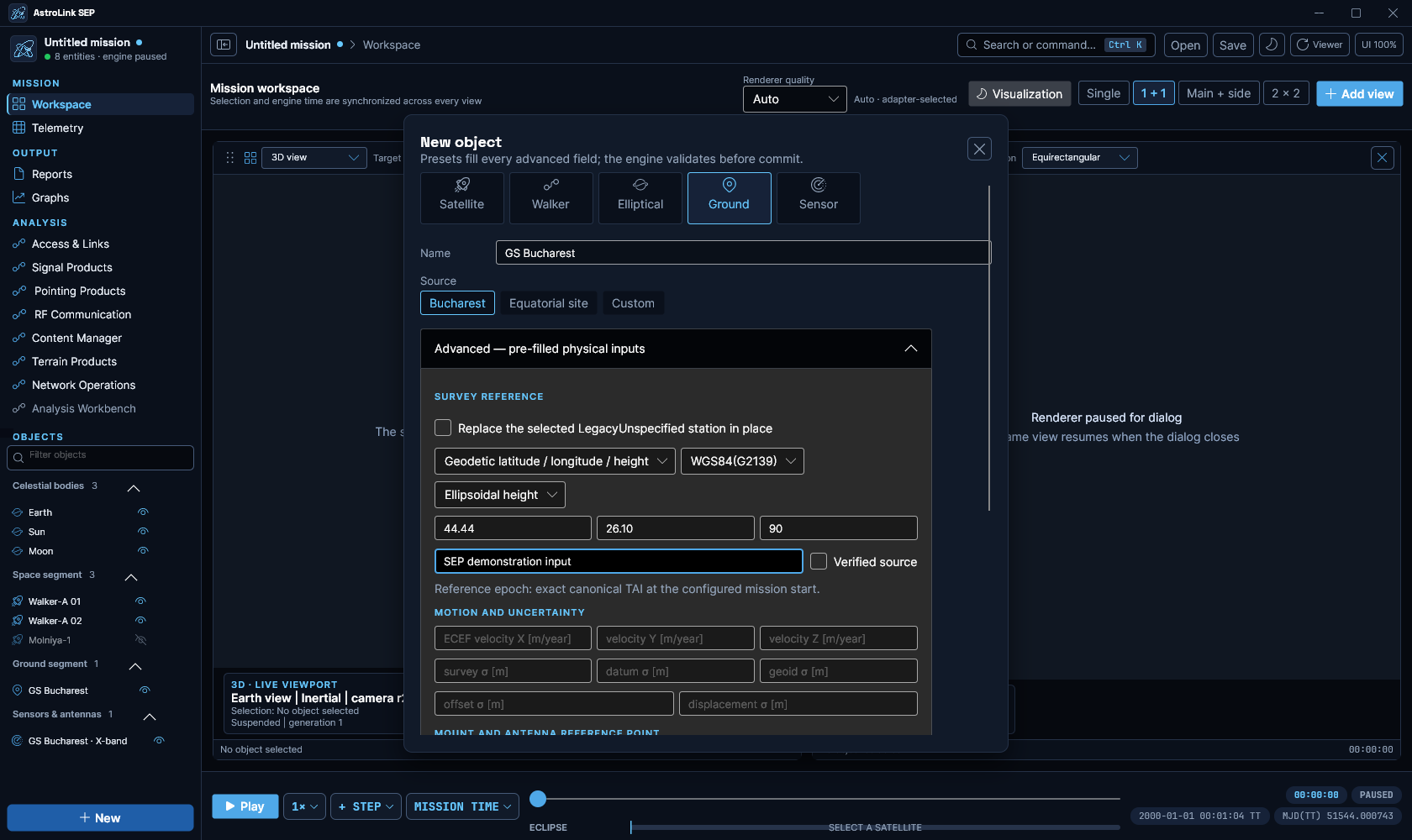
01
Define ground-station locations and antenna configurations alongside your satellites and constellations.
02
Configure line-of-sight, elevation, range and illumination constraints, then inspect access windows, timelines and current-time visibility.
03
Inspect access results with their status and diagnostics, and export CSV outputs for engineering review.
AGS is part of SEP’s current testing programme. Discuss your station network, mission interval and analysis requirements with the AstroLink team.
Discuss access and ground-station analysis →Analysis and output
Follow the physical consequences of the trajectory with spacecraft power, eclipse context, live telemetry and reusable outputs.

01
Define the spacecraft power geometry and inspect live illumination and generated power per satellite.
02
DE440 solar geometry drives power verification and retained penumbra and umbra events on the shared timeline.
03
Move from virtualized live data to reusable graph and report workflows without exporting to another tool first.
For the space sector
SEP supports conversations across the space sector, from satellite mission engineers and operators to startups, established space companies, research teams and investors assessing space ventures.
01
Keep satellites, constellations, timelines, telemetry and analysis views synchronized in one mission context.
02
Evaluate mission concepts and system behavior with a native workspace backed by a high-fidelity propagation core.
03
Explore orbital mechanics, spacecraft power, eclipse events and constellation behavior through inspectable models and visual results.
04
Build on the same physics foundation behind AstroLink’s Doppler-only GNSS-denied navigation research.
05
Discuss the orbit, constellation and spacecraft analyses your mission concept needs, and identify the capabilities to validate as your engineering team grows.
06
Request a technical briefing on SEP, its development status and the mission-engineering workflows it is being built to support.
Independent evaluation starts with context
Review AstroLink alongside GMAT, STK, FreeFlyer, MONTE and ESA AMAT using official sources, documented scope and honest workflow tradeoffs.
Read the comparison guide→SEP at a glance
Spacecraft Engineering Platform (SEP) is AstroLink’s satellite mission analysis software. It brings mission design, high-fidelity orbit propagation, visualization and engineering analysis into one native application. The platform is currently in testing.
SEP models satellites, constellations and ground stations; propagates orbits; and provides Access & Ground Station (AGS) analysis. It also brings together live 3D and ground-track views, telemetry, graphs, eclipse events, spacecraft power and reports.
SEP is intended for satellite mission engineers, operators, space companies, aerospace startups, universities and research teams. Space investors and venture teams can contact AstroLink for a technical briefing on the platform and its development.
SEP is currently in testing and is not yet a public download. Teams can contact ASTROLINK SRL to discuss evaluation requirements, mission workflows, procurement, investment or partnerships.
Evaluate AstroLink SEP
Talk with us about your mission model, analysis workflow and the capabilities you need to validate.
Request a platform briefing→